
Colloquium
The colloquium is currently held at 3:45 PM on Tuesdays in Harriman 137. Cookies, tea and coffee are served from 3:30 PM outside the lecture hall.
Colloquium committee: Jennifer Cano (Vice Chair), Abhay Deshpande, Rouven Essig (Chair), Will Farr, Harold Metcalf, Jesus Perez Rios, Giacinto Piacquadio
Archive of colloquia from 1999 to the present
Spring 2026 Colloquia
| Date | Speaker | Title & Abstract |
|---|---|---|
|
Jan 27 |
Simon Corrodi Argonne National Laboratory |
The Muon’s Wobble: Measuring Muon g-2 to Test the Standard Model The study of magnetic moments, or "g-factors," has a long history of testing fundamental theories, from early measurements of the electron's anomaly providing stringent tests of QED to modern precision probes of the Standard Model. The muon's g-factor is particularly compelling: its larger mass, compared to the electron, renders it significantly more sensitive to virtual contributions from undiscovered particles. The Muon g-2 Experiment at Fermilab recently concluded its mission, measuring the anomalous magnetic moment to 127 parts-per-billion, a four-fold improvement over the historic Brookhaven result. This talk will describe the evolution of these measurements, explain the "wobble" technique, present the final results from Fermilab, and discuss future prospects. |
|
Feb 3 |
Tzu-Chieh Wei Stony Brook University |
From Haldane’s “conjecture” to entangled gapped ground states for quantum computation Haldane in 1981 argued that any integer antiferromagnetic Heisenberg chain has a unique ground state with a nonzero gap above it. This seemed to be at odds with known results from spin-1/2 Heisenberg chain that has gapless excitations from the Bethe ansatz solution and Lieb-Schultz-Mattis theorem. But his results paved the way for recent development of symmetry-protected topological order in early 2000s. One of the exact results supporting Haldane's claim is the construction of a spin-1 rotation-symmetric chain by Affleck, Kennedy, Lieb and Tasaki (AKLT) in 1987 that has an exactly known unique ground state and a provable nonzero spectral gap. AKLT’s construction can be extended to any lattice, such as the hexagonal and square lattices, already presented in one of their original works. The corresponding wavefunctions display no magnetic ordering and exponentially decaying correlations, but whether the models have nonzero gap was not known at that time. Motivated by the quest for universal quantum computation, we were able to show that these AKLT wave functions can be used to perform universal quantum computation. Moreover, we also rigorously established the existence of nonzero spectral gap in some of the two- and three-dimensional AKLT models, including the one on the hexagonal lattice and another one on the decorated diamond lattice. These developments will be covered in this talk. As of the present, it was not known whether one could prepare these higher-dimensional AKLT wave functions efficiently and deterministically on quantum computers. We will also present schemes for efficient (constant-time) preparation of an ensemble of random-bond AKLT states on any finite lattice. |
|
Feb 10 |
John Beggs Indiana University |
The Cortex and the Critical Point Condensed matter physics provides a framework for understanding experiments on ensembles of neurons. Within this framework, cascades of activity among cortical neurons follow the same equations that govern avalanches in granular materials, complete with power laws, an exponent relation, and a universal scaling function. These “neuronal avalanches” also show that the cerebral cortex operates near a critical point where many of its information processing functions are optimized, analogous to peaks in susceptibility and correlation length seen at a continuous phase transition. I will review progress in this field over the past 20 years and point to the new frontiers it has opened in human health and deep learning. |
|
Feb 17 |
Kenneth Lanzetta Stony Brook University |
Cosmology with the Condor Array Telescope Most of the baryonic matter of the Universe is predicted to reside not in galaxies but rather in diffuse gas that traces the dark-matter filaments that make up the “cosmic web” underlying large-scale structure. The gas is heated by gravitational collapse and ionized by the metagalactic radiation field, producing faint emission that illuminates the otherwise invisible dark-matter scaffolding. Detecting such emission requires sensitivity to surface-brightness levels far below those accessible to conventional astronomical instruments and has therefore remained a major observational challenge for decades. To meet this challenge, we developed the Condor Array Telescope, a purpose-built optical telescope array optimized specifically for ultra–low–surface-brightness imaging of diffuse, extended emission. In this talk, I describe the Condor Array Telescope and its prospects for directly imaging the cosmic web in emission across most of cosmic time. |
|
Feb 24 |
-- |
No Colloquium |
|
Mar 3 |
David Weiss Penn State University |
Exciting 1D gases 1D gases with point contact interactions are special because they are integrable many-body systems, which means that they have many extra conserved quantities, beyond the usual few (energy, momentum, etc.). I will explain the previous sentence in more detail and then show how we make bundles of 1D Bose gases in the lab, the various ways we excite them out of equilibrium, and how we use them as model systems for studying quantum dynamics. Perhaps especially notable to the Stony Brook physics community, certain insights we achieve are surprisingly applicable to the early time dynamics of relativistic heavy ion collisions. |
|
Mar 10 |
Jo Dunkley Princeton University |
The Start of the Simons Observatory The Simons Observatory is a new millimeter-wave observatory in Chile that recently started observations. Its largest 6-meter telescope is measuring the cosmic microwave background (CMB), the earliest image we have of the universe, over half the sky. Its smaller telescopes are seeking a signal imprinted by gravitational waves from the early universe. The large-telescope survey overlaps with many optical surveys and provides a route to mapping the cosmic web of gas and dark matter. By surveying half the sky every couple of days, we also hope to see new types of transient astronomical events in millimeter-wavelengths, and track the light-curves of thousands of active galactic nuclei. In this talk I will describe the observatory and its science plans, and show some early data. |
|
Mar 17 |
-- |
Spring Break (No Colloquium) |
|
Mar 24 |
-- |
No Colloquium |
|
Mar 31 |
Frederick Walter Stony Brook University |
The Dark Side of the Sun Solar flares and their accompanying coronal mass ejections have had only minimal effect on life on our planet for the past 4 billion years. But today secondary effects of energetic solar events can have devastating consequences for our electrical infrastructure and communications systems. The September 1859 Carrington event, the first recorded solar flare, remains one of the strongest on record. The geomagnetic storm which struck the next day weakened the Earth's magnetic field by over 900 nT (nearly 1%), produced an aurora seen as far south as Cuba and Tahiti, and induced currents in telegraph wires. Weaker events today wreak havoc with the electrical grid, upset GPS navigation, and displace satellites from their intended orbits. Following an overview of stellar magnetism and flaring mechanisms, I will discuss the known large solar events and their consequences. Solar astronomers are not yet able to predict energetic solar events, and the small number of historical events limits our ability to predict statistically when the next major flare might be expected. Data from the Kepler and TESS missions now let us explore flare rates and strengths from a large sample of stars. I shall discuss how stellar data are improving our understanding of large solar events and their risks to today's society. |
|
Apr 7 |
Stony Brook University |
Undergraduate Colloquium
|
|
Apr 14 |
Chetan Nayak Microsoft CANCELLED |
Roadmap to a Topological Quantum Computer Microsoft’s tetron qubit marks a key advance in topological quantum computing. It is built from hybrid superconductor–semiconductor nanowires hosting pairs of Majorana zero modes. These devices are a result of a long-term materials program. In this talk, I will describe this program and present the latest results on these devices. I will also outline our roadmap from single tetrons to multi-qubit arrays capable of quantum error correction, charting a concrete path toward scalable, reliable quantum computation. |
|
Apr 21 |
Juan Estrada Brookhaven National Laboratory |
Dark Sector Exploration with Low-Noise Silicon Detectors I will discuss current ideas and experimental efforts to explore the dark sector using a new generation of ultra-low-noise silicon detectors. Technologies such as Skipper-CCDs, SiSeRO devices, Skipper-CMOS sensors, and MAS-CCDs enable the measurement of extremely small ionization signals in silicon, reaching sensitivities at the level of single electron–hole pairs. These capabilities open new opportunities to search for light dark matter and other weakly interacting particles. This talk will review the detector concepts and recent progress in direct dark matter searches using low noise CCDs. I will also discuss how these low-threshold sensors are being deployed in underground experiments, particle beams, and astronomical observations, and how scaling these technologies to larger detectors may allow us to probe previously inaccessible regions of dark sector parameter space. |
|
Apr 28 |
John Parmentola RAND Corporation |
How Could Sea Levels Fall by 400 Feet During an Ice Age? Sea levels fell by about 400 feet (120 meters) during the great ice ages of the past million years as enormous continental ice sheets grew across Greenland, North America, and Eurasia. Explaining how such vast quantities of ocean water could be transferred to land as ice remains one of the central questions of climate science. Although the Earth’s orbit geometry slowly changes over time, the planet receives nearly the same total solar energy each year. Ice ages, therefore, cannot be explained simply by small changes in the Sun’s annual energy supply. Instead, orbital geometry redistributes solar energy across latitudes and seasons. The Arctic climate system is governed primarily by summer melt energy, while the tropical oceans respond to the cumulative storage of solar energy through evaporation, ocean heat content, and the transport of moisture toward higher latitudes. In this talk, I will describe a mechanism I call the Countervailing Obliquity–Precession Effect (COPE). COPE arises from changes in orbital geometry that reduce summer heating in the Arctic while simultaneously increasing seasonal energy accumulation in the tropical zone. This redistribution alters the balance between high-latitude ice melt and tropical evaporation, potentially influencing the growth of continental-scale ice sheets. Satellite observations of the Earth’s radiation budget show that a measurable fraction of this redistributed energy persists in the tropical climate system today. The COPE predicts that the tropical zone absorbs different amounts of solar energy during two halves of the Earth’s annual orbit. Satellite measurements from the CERES mission reveal a persistent net tropical zone asymmetry of roughly 1 W/m² over the past two decades, indicating that part of the redistributed orbital energy remains within the climate system rather than being fully offset by cloud reflection and thermal emission to space. Evidence suggests that COPE operated during Marine Isotope Stage 19c (MIS 19c), an interglacial about 800,000 years ago that closely resembles the present Holocene (MIS 1). For both intervals, the energy accumulated in the tropical zone exceeds—by many times—the energy required to evaporate enough ocean water to lower sea levels by 400 feet, independent of climate feedback mechanisms. Taken together, these results suggest that the redistribution of orbital energy through the Earth system may play an important role in explaining how ice ages begin and how sea levels can fall by hundreds of feet over geological timescales. |
|
May 5 |
Derek Teaney Graduate Program Director |
Graduate Colloquium |
Archived Colloquium Schedules
Date Speaker Title & Abstract Aug 26 Chang Kee Jung
Physics and Astronomy Department Chair
Stony Brook UniversityChair's Colloquium
Sep 2 Joanna Kiryluk
Stony Brook University
IceCube High Energy Neutrinos: Cosmic Messengers and Probes of the Structure of Matter
IceCube is a one cubic kilometer neutrino observatory, completed in 2010 at the South Pole in Antarctica. In 2012, IceCube detected the first Peta electron-volt neutrino events and measured an unexpectedly large diffuse astrophysical neutrino flux. Since then, IceCube has characterized this flux with different event selection methods and event topologies, cascades and tracks induced by neutrinos of different flavors in the TeV-PeV energy range. The results are well described by a single power law with a spectral index of 2.5, softer than expected. Most recent precision data indicate a preference of a broken power law over a single power law. The origin(s) of the diffuse flux remains a largely open question.
In 2017, an IceCube neutrino alert from the direction of the TXS 0506+056 galaxy triggered a multi-wavelength campaign of follow-up observations and identified this active galaxy as a cosmic ray accelerator and a source of both high energy neutrinos and gamma rays: a breakthrough in multi-messenger astronomy. Since then, IceCube found evidence that astrophysical neutrinos are also correlated with the NG1068 active galaxy and with the Galactic Plane.
In this talk I will discuss IceCube results on the high energy neutrino diffuse flux and searches on possible neutrino sources, results on the neutrino and anti-neutrino scattering cross sections and implications for the structure of matter, as well as detector future capabilities.
Sep 9 Alice Shapley
University of California Los Angeles
The JWST Spectroscopic Revolution in Galaxy Formation
Understanding the formation and evolution of galaxies remains one of the great challenges of modern cosmology. Key outstanding questions include: What are the physical processes driving the formation of stars in galaxies? How do galaxies exchange material with their intergalactic environments? How do the impressive variety of galactic structures that we observe today assemble? How do supermassive black holes affect the evolution of their host galaxies? We present a brief history of rest-optical spectroscopic probes of the galaxy formation process at high redshift, ranging from early ground-based attempts to the very latest results from the James Webb Space Telescope, which has revolutionized our ability to learn about the most distant galaxies in the universe. We focus in particular on questions related to the evolving enrichment and physical conditions in the interstellar medium of star-forming galaxies in the early universe, as these place critical constraints on the cycle of baryons through galaxies over cosmic time.
Sep 16 Didier Queloz
University of Cambridge
C.N. Yang Colloquium: Exoplanet and Life in the Universe
Sep 23 Subir Sachdev
Harvard University
Critical quantum liquids and the cuprate high temperature superconductors
Complex many-electron entanglement can give rise to quantum states of matter that lack any well-defined particle-like excitations. Recent theoretical advances in understanding such states have provided significant insight into the diverse phases of the cuprate materials, including high-temperature superconductivity. One such critical state is a quantum spin liquid, in which the charge of some electrons is localized, while their spins remain entangled in a scale-invariant manner; it offers a description of the pseudogap phase. Another distinct critical state is associated with the collective dynamics of electron charge, characteristic of the strange metal regime; its theoretical description builds on concepts from the Sachdev-Ye-Kitaev (SYK) model.
Sep 30 --
No Colloquium
Oct 7 Ilsa Cooke
University of British Columbia
Unraveling the journey of interstellar hydrocarbons – from the cold clouds to solar systems
The interstellar medium is a fascinating place to study chemical reactions! This chemistry is initiated by energetic particles and photons, forming ions and radicals that can react in the gas phase and on the surface of dust grains, even at temperatures below 10 K. It is the ultimate physical chemistry laboratory!
Today, over 300 molecules have been detected in the interstellar medium, including exotic and unstable species as well as many organic molecules that are also found on Earth. Of these, polycyclic aromatic hydrocarbons (PAHs) are expected to be the most abundant class of organic molecules in space; however, their interstellar lifecycle is poorly understood.
I will present our recent detections of large PAHs, the cyanopyrenes and cyanocoronene, in our radio observations of the dense molecular cloud TMC-1, the largest molecules detected to date by radio astronomy! The high abundance of pyrene and coronene relative to other small aromatics detected so far in TMC-1 is difficult to explain using currently proposed chemical mechanisms. I will discuss future directions in unravelling PAH chemistry in the interstellar medium and the necessity of complementary laboratory measurements.Oct 14 --
Fall Break (No Colloquium)
Oct 21 Adam Burrows
Princeton University
The Emerging Theory of Core-Collapse Supernova Explosions
The theory of compact-object birth and supernovae is now entering a new and productive phase of rapid insight into the mechanism and systematics of explosion. The panoramic perspective provided by the recent access to tens of state-of-the-art 3D core-collapse simulations taken to late times has revealed potential correlations between supernova observables and physical trends with progenitors. A productive dialogue is slowly emerging between theorists and observers that promises to transform the study of core-collapse supernova explosions and to inaugurate a new era of physical characterization missing from the past. Models now explode without artiface and theory is on the cusp of being able to make predictions that seemed out of reach only a few years ago. We have discovered correlations between explosion energy, neutron star gravitational birth masses, the yields of the chemical elements, debris morphologies, pulsar kicks, and neutrino and gravitational-wave emissions. However, while I contend the core-collapse supernova problem is in broad outline and qualitatively now solved, there is much yet to do in supernova theory before it can robustly and quantitatively explain the variety of supernova observations. I will close with suggested paths forward to achieve this ultimate goal.
Oct 28 Peter van Nieuwenhuizen
Stony Brook University
Spin @ 100. How spin was discovered 100 years ago.
How the Zeeman (1896) and Stark (1913) puzzles of spectra were solved by Goudsmit and Uhlenbeck’s concept of spin in 1925; and how spin found its natural place in the new quantum mechanics of Heisenberg (1925), Schrödinger (1926), Pauli (1927) and Dirac (1928).
In 1896 Pieter Zeeman, assistant of Heike Kamerlingh Onnes and Hendrik Lorentz at Leyden, discovered that spectral lines broadened if their sources were put in a magnetic field. Lorentz had the year before discovered the Lorentz force, and used it to predict that spectral lines should split into triplets or doublets. In 1897 Zeeman indeed detected such triplets and doublets, and in 1902 he and Lorentz received the second Nobel prize, but later it was found that the splittings were much more complicated. Thirty years of utter confusion and despair followed, but in 1925 several discoveries in rapid succession solved the problems of the “normal” and “anomalous” Zeeman effect: Pauli’s exclusion principle (January), Heisenberg’s first paper on QM (July), Goudsmit and Uhlenbeck’s spin (October), and the first paper on quantum field theory by Born, Heisenberg and Jordan (November).
In January 1926 Schrödinger published his first of six papers on quantum mechanics, still without spin, but in February the Thomas factor of 2 confirmed the necessity of spin. In 1927 Pauli constructed a nonrelativistic two-component theory for spinors, and in 1928 Dirac finally constructed his relativistic spinor theory. Spin and the value g = 2 of the anomalous magnetic moment came out instead of being put in by hand. We shall recount this fascinating history, explain the physics, and intersperse it with numerous anecdotes.Nov 4 --
Election Day (No Colloquium)
Nov 11 Priya Natarajan
Yale University
Illuminating Cosmic Origins: Tracing the Birth of the First Black Holes
A profound transformation is underway in our understanding of how the very first black holes emerged and evolved in the infant Universe. These cosmic seeds—precursors to today’s supermassive black holes—offer a unique window into the earliest stages of structure formation. The combined power of JWST, Chandra, and Hubble is now revealing the signatures of their birth, pointing to multiple seeding pathways. Among these, the direct collapse of pristine gas clouds has gained striking new support, alongside the classical channel of stellar remnants from the first generation of stars. In parallel, observations of the stochastic gravitational wave background and advances in cosmological simulations are beginning to connect these formative epochs to the later assembly of galaxies and quasars. In this talk, I will chart our evolving understanding of black hole origins—how light and heavy seeds form, grow, and merge—and explore how forthcoming observations, including those from LISA, promise to discriminate among competing formation scenarios. I will conclude by reflecting on the broader implications for cosmic evolution and on what these elusive beginnings reveal about the invisible architecture of our Universe.
Nov 18 Xin Qian
Brookhaven National Laboratory
From θ₁₃ to DUNE: Precision Neutrino Physics & Technology Innovation
Neutrinos, central to both the Standard Model and our understanding of the universe, revealed through oscillations the first particle-physics evidence of physics beyond the minimal Standard Model. The rapid discovery of a non-zero θ₁₃ at Daya Bay opened the path to addressing several fundamental questions in neutrino physics, while the resolution of anomalies—historically crucial for breakthroughs—has deepened our understanding and driven detector innovation. In this context, the development of liquid-argon time projection chambers (LArTPCs), together with associated advances such as Wire-Cell reconstruction in MicroBooNE, has pushed the frontier of experimental capability. Looking ahead, DUNE, Hyper-Kamiokande, and JUNO, now under construction or beginning data taking, promise transformative results: advancing the picture of neutrino mass and mixing, serving as powerful neutrino observatories, and opening new avenues for discoveries beyond the Standard Model—marking the beginning of an exciting new era in precision neutrino physics and technology-driven exploration.
Nov 25 --
Thanksgiving Week (No Colloquium)
Dec 2 Abhay Pasupathy
Columbia University
From Supersonic Currents to Cavity-Altered Superconductors
I will discuss the use of scan probe microscopy to gain microscopic insight into two separate quantum phenomena in solids.
In the first experiment, we explore how electrons in ultra-clean solids can behave as a viscous fluid, enabling transport far from the textbook ohmic or ballistic regimes. I will discuss a bilayer-graphene electronic de Laval nozzle that accelerates carriers to supersonic speeds, producing a viscous electron shock. Discontinuities in transport and local potential flattening observed by Kelvin probe microscopy are consistent with a compressible, hydrodynamic flow that breaks the electronic sound barrier—opening a path to intrinsically nonlinear devices that exploit shocks.
In the second experiment, I will discuss how we can affect superconductivity by engineering a material’s electromagnetic environment. Using a “dark” hyperbolic cavity formed by hexagonal boron nitride interfaced with the molecular superconductor κ-(BEDT-TTF)₂Cu[N(CN)₂]Br (κ-ET), we realize resonant coupling between hBN hyperbolic modes and a molecular vibration implicated in pairing. We use magnetic-force microscopy to detect the Meissner response at the interface of the two materials. We observe a marked suppression of superfluid density at the interface—an effect absent in non-resonant controls.Date Speaker Title & Abstract Jan 28 Andre De Gouvea
Northwestern University
The Brave Nu World
The discovery of nonzero neutrino masses shook the particle physics world at the turn of the 21st century and remains the only concrete evidence that there is something missing from the standard model of particle physics. I provide an overview of the current status of neutrino physics, including some of the open questions and the many avenues we are pursuing to answer them.
Feb 4 Raymond Blackwell
Stony Brook University
Visualizing Correlated Phenomena via Scanning Tunneling Microscopy
Strong interactions between electrons in a material give rise to a diverse set of phenomena including superconductivity, density waves, and magnetism. One of the most powerful techniques to study these correlated phenomena is Spectroscopic Imaging Scanning Tunneling Microscopy (SI-STM), a real space probe capable of visualizing local electronic information at sub-nanometer length scale. In this talk, I will discuss the insights that SI-STM provides about the normal state in the recently discovered high Tc superconductor La3Ni2O7. Additionally I will show evidence that ytterbium dopants drastically alter the properties of graphene leading to spatial heterogeneity in the electronic structure and the appearance of a charge density wave.
Feb 11 Jainendra Jain
Penn State University
Absolutely mindboggling! Weirder than we ever thought.
The history of physics is replete with examples, referred to as paradigm shifts, where a complex and apparently disconnected set of phenomena is unified by a more fundamental principle. In this talk, I will show how the enormously rich and mysterious phenomenology of 2D electrons in a magnetic field becomes obvious when viewed from the perspective of a new kind of emergent particles called the composite fermions. In particular, the composite fermions are seen to be the fundamental building blocks of the fractional quantum Hall states, which are among the most stunning, the most consequential, and the best understood strongly correlated states discovered in nature. I will mention the latest developments, intriguing ideas for fault tolerant quantum computation, new surprises, and open issues. The talk will be accessible to first year graduate students.
Feb 18 Tom Hartman
Cornell University
Black Holes in Quantum Gravity: Old Puzzles and New Connections
Black holes in quantum gravity are complex objects, and the theory that governs them provides a bridge between quantum field theory, statistical mechanics, and quantum information theory. In this talk, I will describe some of these connections and give a status report on the quantum theory of black holes. The emphasis is on the recent discovery that spacetimes with higher topology --- multiple black holes, connected through their interiors --- play an important role in the path integral of quantum gravity. The talk will be an overview geared toward a general physics audience.
Feb 25 Dominik Schneble
Stony Brook University
Simulating Waveguide QED with Atomic Matter Waves
Understanding and harnessing light-matter interactions in novel contexts is central to the development of modern quantum technologies. One example is the emerging field of waveguide quantum electrodynamics (wQED) which investigates the coherent coupling between one or more quantum emitters and an engineered low-dimensional photonic bath. While recent experiments have observed modified spontaneous emission, bound-state mediated interactions, and superradiance, a clean access to the underlying mechanisms often remains challenging. We approach wQED with an unconventional platform in which artificial quantum emitters, realized with ultracold atoms in an optical lattice, undergo spontaneous radiative decay by emitting single atoms, rather than single photons. I will introduce the unique aspects of our matter-wave platform and present some recent work on simulating radiative many-body effects at the boundary between atomic physics, quantum optics and condensed-matter physics.
Mar 4 Alan Robock
Rutgers University
Global Famine after Nuclear War
The world as we know it could end any day as a result of an accidental nuclear war between the United States and Russia. The fires produced by attacks on cities and industrial areas would generate smoke that would blow around the world, persist for years, and block out sunlight, producing a nuclear winter. Because temperatures would plunge below freezing, crops would die and massive starvation could kill most of humanity. Even a nuclear war between new nuclear states, such as India and Pakistan, could produce climate change unprecedented in recorded human history and massive disruptions to the world’s food supply.
This talk will show climate and crop model simulations, as well as analogs, which support this theory. It will also discuss policy changes that can immediately lessen the chance of such scenarios happening and that can lead to the abolition of nuclear weapons. The myth of nuclear deterrence has allowed nuclear weapons to persist for too long. However, as a result of international negotiations pushed by civil society led by the International Campaign to Abolish Nuclear Weapons (ICAN), and referencing this work, the United Nations passed the Treaty on the Prohibition of Nuclear Weapons (TPNW) on July 7, 2017. On December 10, 2017, ICAN accepted the Nobel Peace Prize and the TPNW came into force on January 22, 2021, but the nine nuclear nations continue to ignore the TPNW and the will of the rest of the world. An option for physicists interested in getting involved is to join the Physicists Coalition for Nuclear Threat Reduction, http://physicistscoalition.org/, a project to engage and activate the global physics community, which is headquartered at the Princeton University Program on Science and Global Security.
Mar 11 Hui Cao
Yale University
Four-Decade Search for Anderson localization of light
Anderson localization marks a halt of diffusive propagation in disordered systems, and it exists for various types of waves. Despite extensive studies over the past 40 years, Anderson localization of light in three dimensions remained elusive, leading to the question of its very existence. Recent computational advances enabled large-scale numerical calculations, allowing us to conduct brute-force simulations of light transport in fully disordered three-dimensional systems with unprecedented dimension and refractive index difference. We show numerically three-dimensional localization of vector electromagnetic waves in in random packings of metallic spheres, in sharp contrast to its absence in the dielectric systems. We also identify a mobility edge that separates diffusive transport and Anderson localization, and reveal a sharp transition from diffusion to localization for light. Our work opens a wide range of avenues in both fundamental research related to Anderson localization and potential applications using three-dimensional localized light.
Mar 18 -- No Colloquium. Spring Break. Mar 25 Thomas Allison
Stony Brook University
Momentum-Space Imaging of Electron and Exciton Dynamics in 2D Materials
Our conceptual pictures and theoretical formulations regarding the dynamics of quasi-particles in crystalline materials, such as electrons, holes, and excitons, are formulated in momentum space. For example, when we think about how a semiconductor absorbs or emits light, we draw the band structure and arrows connecting the valence band and conduction band, along with scattering mechanisms characterized by energy and crystal momentum. However, our observables of these phenomena involve integrals over many states in momentum space, and are also blind to so-called “dark” states that do not interact with light. Significant interpretation is then required to connect optical spectra to the underlying momentum-space dynamics, and it is easy to get these interpretations wrong.
Recently, breakthroughs in technology for time- and angle-resolved photoemission (tr-ARPES), developed at Stony Brook and a few other labs, make direct momentum-space snapshots of electron dynamics across the full Brillouin zone no longer just a theoretical construct but a recorded reality. In this talk, I will discuss both the optical science behind these recent breakthroughs in tr-ARPES and recent results from my lab. Specifically, I will discuss pseudo-spin dynamics in graphene, valley polarization dynamics in monolayer WS2, and the mixture of metastable exciton states produced in MoSe2/WS2 heterostructures after above-bandgap excitation. Direct visualization of momentum-space wave functions enables new discoveries unseen in previous measurements in each case, but this only represents a small glimpse of the science now accessible with these new techniques. Finally, I will present an outlook for some upcoming experiments and where the field is going with further advances in the techniques.
Apr 1 Christoph Paus
Massachusetts Institute of Technology
The FCC: A Feasible Circular Collider at CERN?
In 2020, the U.S. and CERN signed a bilateral agreement enabling U.S. participation in the Feasibility Study for a Future Circular Collider, which CERN Council initiated in 2021 to evaluate the cost, technical design, and site feasibility. This study will conclude in March 2025.
In this presentation I will take a look at this daring project, which is bound to take over the precision and energy frontier for decades to come. I will discuss its major goals, potential and opportunities for collaboration.
Apr 8 Katerina Chatziioannou
California Institute of Technology
Neutron stars and dense matter with gravitational waves
Detections of neutron stars in binaries through gravitational waves offer a novel way to probe the properties of extremely dense matter. In this talk I will describe the properties of the signals we have observed, what they have already taught us, and what we expect to learn in the future. I will also discuss how information from gravitational waves can be combined and compared against other astrophysical and terrestrial probes of neutron star matter to unveil to the properties of the most dense material objects that we know of.
Apr 15 Undergraduate Colloquium
Winners of Undergraduate Research Day Poster Presentations and Recipients of the Barry Barish Undergraduate Research Travel Award
- Ryan Brady: Gravitational Lens Modeling of Doubly Imaged Quasars (Advisor: Simon Birrer)
- Nikhil Keer: Electron Probing Simulations of a CO2 Laser-Driven Plasma Wakefield (advisor: Navid Vafaei-Najafabadi)
- Kevin O'Shea: Creating a Sharp Optical Potential Step Using a Digital Micromirror Device (advisor: Dominik Schneble)
- Zahin Shahrior: Constraining the Higgs-Charm Coupling by Analyzing H → cc in ttH Production (advisor: Hannah Arnold)
Apr 22 Thomas Roser
Brookhaven National Laboratory
Sustainability of accelerator and collider facilities
In our world of increasing Global Warming and extreme weather events this talk explores the steps that can be taken to build and operate accelerators and colliders in a more sustainable and responsible way. After a general discussion of sustainability I will describe the work of the ICFA Panel on Sustainable Accelerators and Colliders and the on-going planning efforts towards more sustainable future large accelerators.
Apr 29 David Goldhaber-Gordon
Stanford University
Electrons in twisted layers: design, surprise, and a new set of eyes
When two atomically-thin layers of a material are stacked one atop each other, with a relative twist angle between them, properties can emerge that bear little resemblance to the behavior of the individual layers. Though much can be predicted and designed about such structures, I will share two vignettes about how my students aimed for a particular behavior but found something quite different. The first led to the discovery of the first experimentally-known "orbital magnet", a ferromagnet in which the tiny microscopic magnets that align with each other are not electron spins but tiny circulating current loops. The second surprise was observing resistance that skyrocketed with the application of a magnetic field, along with other striking electronic properties -- this one took years to figure out, but we've recently explained it.
Each of these two surprises turned out to be caused by a structural feature of the layered stack which had not previously been considered important. Finally, I'll describe work toward robotic stacking and a newly-developed technique for mapping the structure of twisted layers, which together might help us get more repeatable control of structure and thus electronic properties in such twisted systems.
May 6 Graduate Colloquium
TBA.
Date Speaker Title & Abstract Aug 27 Chang Kee Jung
Physics and Astronomy Department Chair
Stony Brook UniversityChair's Colloquium
Chair's Colloquium Slides (PDF)Sep 3 Rachel Bezanson
University of Pittsburgh
UNCOVERing astronomical gems from our backyard to the edges of the observable Universe
NASA's latest great flagship observatory, JWST, was built in part to reveal the earliest moments of cosmic history. In the 2 years since it began releasing data to the public, JWST has enthralled scientists and the public alike with the incredible images and spectroscopic information from astronomical objects as nearby as our solar system and beyond to the most distant reaches of the Universe. The astronomical community has set distance records, found galaxies that may be significantly larger than models suggest could exist, and demonstrated that in some cases galaxy and supermassive black hole formation was earlier and more rapid than we had ever expected. In this talk, I will highlight some of the exciting results from the UNCOVER (Ultradeep NIRSpec and NIRCam ObserVations before the Epoch of Reionization (https://jwst-uncover.github.io/) Treasury program. The UNCOVER program began in November 2022 with ultradeep NIRCam images of the Abell 2744 cluster ("Pandora's cluster") and within the same observing cycle targeted ~700 JWST-selected objects with deep NIRSpec PRISM spectra. These rich data have enabled spectroscopic studies of anticipated galaxy populations, including some of the most distant galaxies at cosmic dawn and the lowest mass systems that reionized the Universe. However, the same dataset has also revealed the unexpected, including extreme early supermassive black holes, dusty quiescent galaxies, and even low mass brown dwarfs in our own Milky Way. When combined with the multitude of additional multiwavelength data from other early JWST observations and HST, Chandra, ALMA, the VLT, etc., UNCOVER has helped to establish Abell 2744 as one of the premiere extragalactic fields.
Sep 10 Chiara Mingarelli
Yale
The NANOGrav Experiment: current results and future directions
Galaxy mergers are a standard aspect of galaxy formation and evolution, and most large galaxies contain supermassive black holes. As part of the merging process, the supermassive black holes should in-spiral together and eventually merge, generating a background of gravitational radiation in the nanohertz to microhertz regime. An array of precisely timed pulsars spread across the sky can form a galactic-scale gravitational wave detector in the nanohertz band. I describe the current efforts to develop and extend the pulsar timing array concept, together with recent evidence for a gravitational wave background, and efforts to constrain astrophysical phenomena at the heart of supermassive black hole mergers.
Sep 17 David Gross
KITP
UCSBFifty Years of Quantum Chromodynamics (The Theory of the Strong Nuclear Force)
I shall discuss the past, present and future of this remarkable theory.
Sep 24 Karsten Heeger
Yale
Probing the Nature of Neutrino Mass
Neutrinos are among the most abundant particles in the Universe and may hold the key to understanding the predominance of matter over antimatter in the cosmos. The search for neutrinoless double beta decay is a unique way to probe the nature of neutrinos. Observing this process would demonstrate that the neutrino is its own antiparticle (Majorana particle), provide new means for generating mass, and would revise our foundational understanding of physics. CUORE, the Cryogenic Underground Observatory for Rare Events, has created the coldest cubic meter in the known Universe for a bolometric search for this rare decay. In this talk, I will report on recent results from CUORE and the plans for CUPID, a ton-scale upgrade with neutrino mass sensitivity beyond the inverted mass ordering.
Oct 1 Ken Dill
Stony Brook University
The Origins of Life: A new look at an old problem. A physics perspective.
How did the first living cells come into being from the earth’s molecular soup about 4 billion years ago? It appears to have been an unrepeatable singularity. Despite much speculation – maybe RNA molecules came first, or proteins, or chemical networks – there’s not yet a consensus origins story. We’ve taken a new look, from a physics perspective. The first step must have been a non-equilibrium adaptive and stable stochastic process that drove an irreversible transition. Also, although the question of how today’s biological proteins could have arisen from random sequences seems like a “needle-in-a-haystack” problem, such problems are often readily solved through the statistical physics of disorder-to-order processes. This new look is leading to specific experimental predictions, and our recent experiments look promising.
Oct 8 Eden Figueroa
Stony Brook University
Building the Quantum Internet of the US: The SCY-QNet collaboration.
The Quantum Internet (QI) concept was proposed in the late 2000s, inspired by advancements in network technologies and light-matter quantum interfaces. It is based on interconnecting quantum nodes, including quantum memories (QM) and entanglement sources, to distribute quantum entanglement between quantum network (QN) nodes. To achieve the benefits of the QI, such as long-distance entanglement distribution and networked quantum computing, one must integrate quantum operations across a collection of interconnected Hamiltonians, together with contemporaneous networking principles and layered architectures.
In this colloquium, we will present our implementation of a quantum-enabled Internet (QEI) based on this physics-centric layered network architecture. We will introduce a quantum network paradigm adopting an operational hierarchy allowing the execution of QN processes by simultaneously driving sets of remotely located Hamiltonians at QN nodes. We will also present the experimental realization of these concepts using a real-world quantum network connecting Stony Brook University, Brookhaven National Laboratory and the Commack Data Center. Lastly, we will discuss the Stony Brook – Columbia -Yale quantum network (SCY-QNet), which is an expansion of our current efforts, aimed to create a 10-node, 350 km long quantum internet prototype connecting advanced quantum processing units.
Oct 15 -- No Colloquium. Fall Break. Oct 22 Stefano Spagna
Quantum Design
Correlative Microscopy and Art of Instrument Design
Industrial Physics brings together people, education, and scientific principles in a powerful synergy that drives technological products and services essential to today’s U.S. economy. This presentation highlights one company’s leadership in cryogenic materials characterization platforms and explores how its success stems from identifying emerging technologies and transforming them into specialized measurement instruments tailored to solve real world challenges faced by the research community. A key factor of this success story involves partnerships with academic institutions and leading technology companies, nurturing innovative ideas from cutting-edge research conducted in labs worldwide. These collaborations benefit universities in a concrete way by modernizing and restructuring undergraduate and graduate laboratory research and education, developing experiment curricula that reflect the latest research and technological advancements, and reinforcing a commitment to innovation in STEM education.
In this presentation, we will also discuss specific innovations in fields ranging from magneto-optics to correlative microscopy. We will delve into the design elements and workflows made possible by Quantum Design’s award-winning Atomic Force and Scanning Electron Microscopy (AFM-SEM) systems, illustrating their importance in materials research, including studies of 2D materials, nanoparticles, magnetic nanorods, failure analysis, and semiconductor research. Additionally, we will explore how the emerging field of AFM-SEM correlative microscopy enables scientists to analyze a broader range of samples by leveraging the complementary strengths of each technique, generating a wider array of nanoscale information.
Key words: Industrial Physics, STEM education, AFM, SEM, Correlative microscopy, nanoparticles,
failure analysis, semiconductor researchOct 29 Swati Singh
University of Delaware
Searching for dark matter and dark energy with mechanical systems
Abstract: When properly engineered, simple quantum systems such as harmonic oscillators or spins can be excellent detectors of feeble forces and fields. Following a general introduction to this fast-growing area of research, I will focus on using optomechanical systems as sensors of weak acceleration and strain fields. Ultralight dark matter coupling to standard model fields and particles would produce a coherent strain or acceleration signal in an elastic solid. I will discuss the feasibility of searching for this signal using various optomechanical systems. I will also show that current mechanical systems have the sensitivity to set new constraints on scalar field candidates for dark energy. Finally, I will briefly overview the promise of quantum noise limited detectors in the search for beyond the standard model physics.
Brief Bio: Swati Singh is an associate professor in the Department of Electrical and Computer Engineering, Material Science and Engineering, and Physics at the University of Delaware. Her theoretical work spans a wide range of quantum systems: atomic gases, optomechanical oscillators, solid-state qubits, and superfluid helium. Her recent work involves investigating novel applications for quantum sensors, such as detecting gravitational waves, dark matter, and dark energy. She is the recipient of the NSF CAREER award and ITAMP Postdoctoral fellowship. Previously, she was a postdoc at Harvard University, a Ph.D. student at the University of Arizona, a Master's student at the University of British Columbia, and an undergraduate at McMaster University.
Nov 5 -- No Colloquium. Election Day. Nov 12 Jesus Perez-Rios
Stony Brook University
The three-body problem in chemical physics
The three-body problem, such as three bodies interacting through gravity, is paramount in fundamental and mathematical physics. It is well-known that it has no closed solution, and the dynamics is chaotic. The equivalent problem in chemical physics is a termolecular reaction in which three bodies (chemicals) collide, yielding a bound state between two bodies while the third one gets the excess kinetic energy. Termolecular reactions are essential to many chemical and physical systems, from ultracold atoms, determining the system's stability, to plasma physics, explaining the recombination dynamics. In this talk, we will present our methodology for treating termolecular reactions and its application to several intriguing scenarios: cold chemistry, atmospheric physics, and geochemistry. Within cold chemistry, we will show the current understanding of ion-atom-atom recombination reactions essential to understanding the stability of cold ions for applications as a quantum simulator. On the atmospheric physics front, we will present our results on the ozone formation reaction, one of the most relevant reactions in atmospheric physics. Regarding geochemistry, we will discuss our latest results on the sulfur cycle reactions essential to understanding the great oxygenation event, that moment in the history of our planet when the living organism transitioned from anaerobic to aerobic. Finally, we will present some of our efforts toward the theoretical understanding of cluster physics, solvation chemistry, and nucleation dynamics.
Nov 19 Eun-Ah Kim
Cornell
Machine Learning for Quantum Materials
Decades of efforts by the quantum materials research community drove a "data revolution." Modern experimental modalities produce high-dimensional data in large volumes. Unprecedented control and new facilities imply new dimension and new knobs, such as time-resolved probing or scanning probing. Moreover, massive amounts of high-throughput ab-initio data and curated experimental data are becoming accessible to researchers. Much needed are data-centric approaches that accelerate discoveries from these data through synergetic interaction with expert human researchers' insights. A synergy between data science and quantum materials research is essential for such endeavors to result in scientific progress. I will present cases of fruitful collaborations that led to new insights and started to shape an approach to data sets of the new era. Specifically, I will discuss how to use unsupervised learning to discover new physics from large volumes of evolving data and how to use supervised learning to uncover descriptors of emergent properties from limited volume of expertly curated data.
Nov 26 -- No Colloquium. Thanksgiving Week. Dec 3 -- TBA. Date Speaker Title & Abstract Jan 23 -- TBA. Jan 30 JoAnne Hewett
Director of Brookhaven National Laboratory
Professor at Stony Brook UniversityDiscovery Science at Brookhaven Lab
Brookhaven National Lab – a close partner with Stony Brook University – has an exciting and diverse science program. The lab’s research spans the science spectrum from pulling together broad teams to construct and operate large facilities, to individual researchers with valuable contributions to the lab’s priorities. In this talk, I will describe our enduring priorities and future science initiatives, highlighting collaboration with Stony Brook scientists.
Feb 6 Alexei Koulakov
Cold Spring Harbor Laboratory
Brain evolution as a machine learning algorithm
We have entered a golden age of artificial intelligence research, driven mainly by the advances in the artificial neural networks over the last decade or so. Applications of these techniques—to machine vision, speech recognition, autonomous vehicles, natural language, and many other domains—are coming so quickly that many observers predict that the long-elusive goal of “Artificial General Intelligence” (AGI) is within our grasp. However, we still cannot build a machine capable of building a nest, stalking prey, or loading a dishwasher. I will describe how evolution may have shaped the algorithms that the brain is using to solve some of these challenging problems.
Feb 13* Jocelyn Bell Burnell
Oxford University
Tick, tick, tick pulsating star, how we wonder what you are!
In this talk I describe the discovery of pulsars (pulsating radio stars) and what we know about them today.
* This is the Della Pietra General Public Lecture, and will be held in the Della Pietra Family Auditorium - 103 on Tuesday, Feb 13 at 5:00pm, instead of the usually scheduled colloquium time and location.
Feb 20 Mengkun Liu
Stony Brook University
Landau level Nanoscopy at the magic 10 nm scale
In contemporary condensed matter physics and photonics, four length scales are fundamentally interesting and intertwined: 1) Polaritonic wavelength in infrared (IR) and terahertz (THz) frequencies (e.g. plasmon, phonon, exciton, or magnon polaritons), which defines the scale of the light confinement and light-matter interaction; 2) Magnetic lengths, (with he magnetic field), which defines the restricted electron motion in a B field; 3) Diffusion length of the hot carriers at interfaces and the edges, which defines the scale of energy relaxation, and 4) Periodicities of superlattices induced by moiré engineering, which defines the energy scale of emerging quantum phases. For instance, the commensurability of the magnetic lengths (e.g. ~10 nm for graphene at 7T) and superlattice constant (e.g. ~10 nm for twisted bilayer graphene at ‘magic angle’) could lead to exotic fractal quantum states. In this talk, I report 1) A new type of optical spectroscopy technique (aka. Landau level nanoscopy) to tackle all four above-mentioned ‘lengths’ simultaneously in one experiment; 2) A new type of infrared polaritons that can be tuned via magnetic field; 3) A nanoscale probe of the many-body physics through the excitations of magnetoexcitons in graphene across the allowed and forbidden optical transitions. Our approach establishes the Landau-level nanoscopy as a versatile platform for exploring magneto-optical effects at the nanoscale. Our preliminary research also sets the stage for future spectroscopic investigations of the topological and chiral photonic phenomena in complex quantum materials using low-energy photons.
Mengkun Liu (Ph.D. 2012 Boston University) is an associate professor at the Department of Physics and Astronomy of Stony Brook University (since Jan. 2015). His postdoc research was at UC San Diego from 2012-2014. His research interests include the physics of correlated electron systems, low-dimensional quantum materials, infrared and terahertz nano-optics, and ultrafast time-domain spectroscopy. Prizes include the Moore EPI award (2023), NSF career award (2021), and Seaborg Institute Research Fellowships at Los Alamos National Lab (2009, 2010).
Feb 27 Neelima Sehgal
Stony Brook University
Discoveries from CMB-HD, a Stage-5 CMB Facility
CMB experiments have contributed powerful constraints on the fundamental physics of the Universe. Upcoming CMB experiments such as the Simons Observatory and CMB-S4 are poised to extend this progress even further. However, CMB experiments still have a wealth of information to offer beyond these near-term facilities regarding the properties of dark matter, inflation, and light relic particles. In particular, a much lower-noise and higher-resolution wide-area CMB survey can cross a number of critical fundamental physics thresholds and open a relatively untapped window of small-scale, late-time CMB anisotropies. Here I will discuss CMB-HD, a Stage-5 CMB facility, and the discoveries it can enable.
Mar 5 No Colloquium.
-- Mar 12 No Colloquium (Spring Break)
-- Mar 19 Gianfranco Bertone
University of Amsterdam
Gravitational wave probes of dark matter
I will start with an overview of the status of dark matter searches and of the prospects for uncovering its nature in the next decade. I will then focus on the interplay between dark matter, black holes, and gravitational waves, and discuss the prospects for characterizing and identifying dark matter using gravitational waves, covering a wide range of candidates and signals. Finally, I will present some new results on the detectability of dark matter overdensities around black holes in binary systems, and argue that future interferometers may enable precision studies of the dark matter distribution and particle properties.
Mar 26 Smitha Vishveshwara
University of Illinois Urbana-Champaign
Quantum Voyages, Cosmic Journeys: Exploring Physics through the Arts
From ancient monuments to modern day films, the confluence of the arts and physics has resulted in creations that have led to a deeper understanding of nature, to friendly and enchanting ways of perceiving science, to crafting new artistic dimensions, to technological progress, and to pure fun! In this talk, I will describe the educational power of such confluences and recount some of our experiences. In a project-based interdisciplinary course entitled Where the Arts meets Physics, we bring alive the universe and the quantum world through installations and performance – cosmic canopies housing black hole mergers, Warhol versions of Bohr-Einstein debates, and more. Collaborations with theater, music, dance, and circus have led to several performance pieces that explore the magic and beauty of the quantum world and our cosmos: Quantum Voyages; Quantum Rhapsodies; The Joy of Regathering; Cosmic Tumbles, Quantum Leaps, and more. I will share glimpses of the science, stories, the process behind the making of these pieces, and the productions across the globe both in-person and virtually for pandemic times. I will conclude with visions of how these adventures will continue on over the UNESCO endorsed 2025 International Year of the Quantum.
Apr 2 Smadar Naoz
University of California Los Angeles
It's Raining Black Holes...Hallelujah!
The detection of Gravitational Wave emission, of the merger of two black holes, has forever transformed the way we sense our universe. Future detectors, such as the Laser Interferometer Space Antenna (LISA), will open the opportunity to detect the merger of a small (tens of solar mass) black hole with a big, supermassive black hole (SMBH, millions to billions of solar mass). These events are called extreme-mass-ratio inspirals (EMRIs). The popular formation channel for these promising events involves weak two-body kicks from the population of stars and compact objects surrounding the SMBH that can change the small black hole's orbit over time, driving it into the SMBH. On the other hand, perturbations from SMBH companions can excite the SMBH to high eccentricities, thereby forming EMRIs. In this talk, I will demonstrate that combining these two processes is essential to comprehending the dynamics of EMRI progenitors. I will also show that EMRIs are naturally formed in SMBH binaries with higher efficiency than either of these processes considered alone. Thus, it is truly raining black holes! This scenario results in a large stochastic background for future GW detectors such as LISA. Finally, I will demonstrate the implications that this physical mechanism has on tidal disruption events.
Apr 9 --
Undergraduate Colloquium. Apr 16 David J. Wineland
Phillip H. Knight Distinguished Research Chair,
University of OregonAtomic Clocks and Einstein’s relativity
For many centuries, and continuing today, a primary application of accurate clocks is for precise navigation. For example, GPS enables us to determine our distance from the (known) positions of satellites by measuring the time it takes for a pulse of radiation emitted by each satellite to reach us. The more accurately we can measure this duration, the more accurately the distance is known. When performed with a network of satellites, we can find our position in 3 dimensions. Atoms absorb electromagnetic radiation at precise discrete frequencies. Knowing this, a recipe for making an atomic clock is simple to state: we first need an oscillator to produce the radiation and an apparatus that tells us when the atoms maximally absorb it. When this condition is met, we can simply count cycles of the oscillator; the duration of a certain number of cycles defines a unit of time. For example, the internationally agreed on definition of the second corresponds to 9,192,631,770 oscillations of the radiation corresponding to the Cesium “hyperfine” transition. Today, the most precise clocks count cycles of radiation corresponding to optical wavelengths, or around a million billion cycles per second. To achieve high accuracy, many interesting effects, including those due to Einstein’s relativity, must be accounted for. In this talk I will focus on atomic clocks derived from optical transitions in atomic ions.
Apr 23 Chris Quigg
Fermilab
From the "Nuclear Mill" to the Large Hadron Collider and Beyond
A richly illustrated tour of a century of high-energy collisions featuring people, ideas, and stories, free of dense equations and impenetrable jargon.
Apr 30 --
Graduate Colloquium. Date Speaker Title & Abstract Sep 5
Chang Kee Jung
Stony Brook University
Chair's Colloquium
Sep 12
Chris Greene
Purdue University
Universal Physics of 2 or 3 or 4 Strongly Interacting Particles
Recent developments in the field of a few interacting particles with nonperturbative interactions will be reviewed, focusing on ultracold atomic and molecular physics, but with one recent application to the few-nucleon problem as well. Some of these studies are intimately connected with the Efimov effect, while others go beyond the standard Efimov effect with its remarkable infinity of long-range energy levels. Some of our relevant references addressing those topics are listed below.
[1] Nonadiabatic Molecular Association in Thermal Gases Driven by Radio-Frequency Pulses, Phys. Rev. Lett. 123, 043204 (2019), with Panos Giannakeas, Lev Khaykovich, and Jan-Michael Rost.
[2] Nonresonant Density of States Enhancement at Low Energies for Three or Four Neutrons, Phys. Rev. Lett. 125, 052501 (2020), with Michael Higgins, Alejandro Kievsky, and Michele Viviani
[3] Efimov physics implications at p-wave fermionic unitarity, Phys Rev A 105, 013308 (2022), with Yu-Hsin Chen.
[4] Ultracold Heteronuclear Three-Body Systems: How Diabaticity Limits the Universality of Recombination into Shallow Dimers, Phys. Rev. Lett. 120, 023401 (2018), with Panos Giannakeas.Sep 19
Serge Haroche
Nobel Prize Recipient, 2012
C.N. Yang Colloquium
Click the image below to see the event poster!
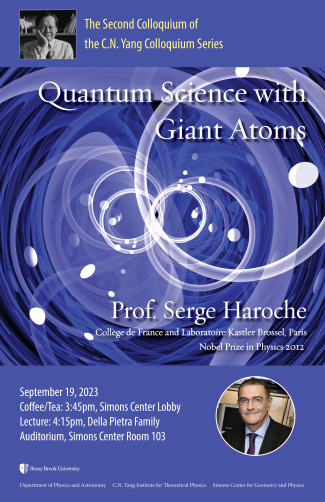
Sep 26
Jan Bernauer
Stony Brook University
Exploring the Standard Model with lepton scattering at the precision frontier
In the last 100 years, accelerator-based nuclear physics has made incredible advances on the precision frontier: the capability to achieve ever shrinking measurement uncertainties, driven by higher luminosities, better detectors, new experimental techniques, and improved theoretical corrections. This is especially true for lepton scattering, predominantly using electron beams, with a renaissance in positron and muon beams.
In this talk, I will cover three topics. First, I will show how such precision measurement can help us understand non-perturbative quantum chromodynamics, focusing on the so-called “proton radius puzzle”, the proton form factors, and the MUSE experiment. Second, I will discuss how one can search for Beyond the Standard Model physics with precision lepton scattering, in the context of the DarkLight@ARIEL measurement and the ATOMKI anomalies. Third, I will explain how Streaming Readout will advance our capabilities for precision measurements.
Oct 3
Antoine Georges
Collège de France, Paris
Flatiron Institute, New York
The Diverse Routes to Strong Electronic Correlations: A Dynamical Mean Field Theory Perspective
From transition-metal oxides, rare-earth and organic compounds to moiré two-dimensional materials, strong electronic correlations have focused enormous attention over several decades. In this talk, I will emphasize three main mechanisms responsible for strong electronic correlations. The proximity to a Mott insulator, and the Kondo effect leading to heavy fermion behavior have been known for a while. Recently however, it became apparent that the properties of a broad family of materials (including iron-based superconductors) cannot be explained within the Mott or the heavy fermion paradigms. The intra-atomic exchange turns out to be the main player responsible for the properties of these "Hund metals."
The classic band theory of solid-state physics must be seriously revised for strongly correlated materials. Instead, a description accounting for both localized atomic excitations and delocalized wave-like quasiparticles is required. I will review how Dynamical Mean-Field Theory (DMFT) fulfills this goal and provides an original physical perspective on strongly correlated electron materials. Thanks to the efforts of a whole community over almost three decades, the theory now provides a practical framework to understand and predict the properties of quantum materials starting from their structure and chemical composition.
Oct 10
No Colloquium.
Fall Break.
Oct 17
Gregory Falkovich
Weizmann Institute of Science
Zero charge and confinement in turbulence
I will describe an attempt to do renormalization in turbulence, considering waves that interact weakly via four-wave scattering (such as sea waves, plasma waves, spin waves, and many others). By summing the series of the most UV-divergent terms in the perturbation theory, we show that the true dimensionless coupling is different from the naive estimate, and find that the effective interaction either decays or grows explosively along the cascade, depending on the sign of the new coupling. The explosive growth possibly signals the appearance of a multi-wave bound state (solitons, shocks, cusps) similar to confinement in quantum chromodynamics.
Oct 24
Aida El-Khadra
University of Illinois Urbana-Champaign
The dance of the muon
More than eighty years after the muon was first identified it may serve as a window to discovering new physics. Thanks to new experimental measurements at Fermilab, the muon’s magnetic moment is now known with an exquisite precision of 189 parts per billion, sharpening the longstanding tension between experiment and theoretical expectations. The experimental measurements will continue to improve with the ultimate goal of reducing the experimental uncertainties to 120 parts per billion. The theoretical calculations of the muon’s magnetic moment must account for the virtual effects of all particles and forces within the Standard Model, where effects coming from virtual hadrons, governed by the strong interactions, are by far the largest sources of theory uncertainty. Recent estimates of hadronic corrections have created puzzles on the theory side, which are currently being investigated. I will discuss the ongoing interplay between theory and experiment that is essential to unlocking the discovery potential of this effort.
Oct 31
Laszlo Forro
University of Notre Dame
Status quo in superconductivity
Since the groundbreaking discovery in 1911 of a zero-resistance state at 4 K – an outcome then dubbed the "impossible result" – the realm of superconductivity has captivated researchers worldwide. One of the primary aspirations since has been to elevate critical temperatures to ambient conditions, a milestone that would revolutionize energy transport, diagnostics, and information technologies, among other sectors. Recent studies have reported achieving this objective under both extreme pressures and even at standard atmospheric conditions. This colloquium provides a comprehensive overview of the present advancements in superconductivity, including findings from our dedicated research endeavors.
Nov 7
Cyrus Dreyer
Stony Brook University
Perfecting quantum imperfections
One of the key impacts of condensed-matter physics is its role in predicting, developing, and understanding materials for technological applications, e.g., transistors, light-emitting diodes, and solar cells. In this context, it is not enough to just understand the pristine materials that make up the devices; the imperfections in those materials must also be characterized and understood. In particular, point defects, which are atomic scale imperfections or impurities in the crystal lattice, are ubiquitous in all materials and can have profound effects on their properties and phenomena. Recently, it has been demonstrated that individual point defects are robust and manipulatable quantum systems that can be used as qubits for quantum computing, emitters of single photons for quantum communication, and nanoprobes for quantum metrology. Ab-initio theoretical methods are crucial for understanding defects in both conventional and quantum devices, since their dilute concentration and small size make them difficult to directly characterize experimentally. At the same time, accurate quantitative knowledge of defect properties is necessary to mitigate detrimental defects and utilize beneficial ones. Defects are also challenging for theory as their properties may depend on highly correlated electronic excited states that have complicated coupling to the host crystal lattice. In this colloquium, I will describe new methods we have developed to study quantum defects from first principles, which allow simple but quantitatively accurate models of defect properties to be parametrized and solved. I will give example of how we are using these methods to search and characterize for quantum defects for the next generation of quantum devices.
Nov 14
Wolf Schäfer
Stony Brook University
Robot Ethics and the Plurality of Theories Problem
This talk is about a difficulty that emerges when humans build powerful things involving science, technology, and society. My case in point are self-driving cars, i.e., automated vehicles (AVs).
Since physicists succeeded in building nuclear bombs, “science has become much too important to be left to the scientists” (Conant). Contemporary examples of this challenge include genome editing with CRISPR in biotechnology and generative artificial intelligence (AI) with large language models in computer science.
The expectation of a dramatic reduction in road traffic accidents after the transition to AVs is well-founded. However, the idea that all traffic accidents will be a phenomenon of the past is utopian. My students and I assume that these accidents will decline, but still happen, and that societal scrutiny of robot car fatalities will increase, especially in some edge cases, where the automotive AI will compute alternative outcomes and make an unforced decision based on different (non-universal) ethical theories, such as utilitarianism or Kantianism.
Nov 21
No Colloquium
Thanksgiving Week.
Nov 28
No Colloquium
--
Dec 5
Keshav Dani
Okinawa Inst. of Sci. & Tech. Graduate University
Imaging photoinduced phenomenon in real and momentum space
Photoemission spectroscopy techniques – wherein one photoemits an electron from a material using a high-energy photon to study its properties – have provided unparalleled insight into materials and condensed matter systems over the past several decades. Among these, there are two particularly powerful and complementary techniques: angle-resolved photoemission spectroscopy (ARPES), which resolves the momentum of the photoemitted electron in the material; and photoemission electron microscopy (PEEM), which resolves its spatial coordinate. Recently, the merger of these techniques into multi-dimensional platforms of photoemission spectroscopy, along with access to the temporal dimension by further incorporating ultrafast spectroscopy techniques, have enabled powerful visuals of the dynamics of photoexcited systems in real and momentum space.
In the first part of the talk, I will discuss some recent work in my lab in visualizing photoexcited carriers in space, time and energy [1, 2]. Applying these techniques to state-of-the-art perovskite photovoltaic films, we will image the performance limiting nanoscale defect clusters in these next-gen solar materials [3], and understand their role in charge trapping [4, 5].
In the second part of the talk, we will turn our attention to imaging momentum space in photoexcited 2D semiconductors and heterostructures [6]. Thereby, we will directly image the distribution of an electron around a hole in an exciton [7] – a hydrogen-like state that forms when a semiconductor absorbs light; visualize dark excitonic states that have largely remained hidden to optical experiments [8], and observe the structure of a moiré trapped interlayer exciton [9].
[1] Nature Nanotech.12, 36 (2017)
[2] Science Advances4, eaat9722 (2018)
[3] Nature580, 360 (2020)
[4] Energy & Environ. Science14, 6320 (2021)
[5] Nature 607, 294 (2022)
[6] Advanced Materials DOI 10.1002/adma.202204120 (2022)
[7] Science Advances7, eabg0192 (2021)
[8] Science370, 1199 (2020)
[9] Nature603, 247 (2022)Spring 2023 Colloquia
Date Speaker Title & Abstract Feb 7
Alyson Brooks
Rutgers
What is the Matter with Dwarf Galaxies?
The large-scale structure of our Universe is well described by a model in which matter is predominantly Cold Dark Matter (CDM). While CDM was initially thought to have trouble reproducing the small scales of our Universe (dwarf galaxies and the central regions of galaxies like the Milky Way), it has generally become accepted in the last decade that a proper treatment of the gas and stars (baryonic matter) can alleviate those tensions. However, the models of energetic "feedback" from stars that have solved some of the tensions in CDM are now running into trouble solving new problems, specifically the "diversity of rotation curves" problem. In this talk, I will highlight the successes and troubles of current baryonic models, and discuss whether self-interacting dark matter (SIDM) might be a better model to explain observations.
Feb 14
Phil Phillips
UIUC
Beyond BCS: An Exact Model for Superconductivity and Mottness
The Bardeen-Cooper-Schrieffer (BCS) theory of superconductivity described all superconductors until the 1986 discovery of the high-temperature counterpart in the cuprate ceramic materials. This discovery has challenged conventional wisdom as these materials are well known to violate the basic tenets of the Landau Fermi liquid theory of metals, crucial to the BCS solution. Precisely what should be used to replace Landau's theory remains an open question. The natural question arises: What is the simplest model for a non-Fermi liquid that yields tractable results. Our work builds[1] on an overlooked symmetry that is broken in the normal state of generic models for the cuprates and hence serves as a fixed point. A surprise is that this fixed point also exhibits Cooper's instability[2,3]. However, the resultant superconducting state differs drastically[3] from that of the standard BCS theory. For example the famous Hebel-Slichter peak is absent and the elementary excitations are no longer linear combinations of particles and holes but rather are superpositions of composite excitations. Our analysis here points a way forward in computing the superconducting properties of strongly correlated electron matter.
[1] E. Huang, G. La Nave, P. Phillips, Nat. Phys., 18, pages 511–516 (2022).
[2] PWP, L. Yeo, E. Huang, Nature Physics, 16, 1175-1180 (2020).
[3] J. Zhao, L. Yeo, E. Huang, PWP, PRB, Phys. Rev. B 105, 184509 (2022).Feb 21
Zoe Yan
Princeton
Microscopy of quantum correlations in an ultracold molecular gas
Ultracold molecules are a promising platform for quantum simulation of spin physics due to their long-range interactions and large set of internal states. To understand the complex many-body states that emerge in these systems, both in and out of equilibrium, new experimental techniques are needed to probe molecule correlations in the strongly interacting regime.
We study the site-resolved dynamics of spin correlations in a gas of ultracold NaRb molecules in a 2D optical lattice. The molecules realize a quantum XY model with long-range interactions. Using a site-resolved Ramsey interferometric technique, we detect oscillations in nearest- and next-nearest-neighbor correlations due to spin interactions. Furthermore, we apply a periodic external microwave field to engineer XXZ spin Hamiltonians with tunable anisotropies. The correlations are measured by dissociating the molecules and detecting the corresponding Rb atoms with single-site resolution using a quantum gas microscope. The techniques presented here open new doors for probing quantum correlations in complex many-body systems of ultracold molecules.
Feb 28
Feliciano Giustino
UT Austin
The polaron turns ninety
In 1933, Lev Landau wrote a 500-word article analyzing what might happen when an electron travels through a crystal lattice. That deceivingly simple paper marked the birthdate of the concept of polarons. Ninety years on, new experiments and new high-performance computing methods are helping us to shed light on these ubiquitous yet elusive entities. Polarons are emergent quasiparticles that arise from the interaction between fermions and bosons. In crystals, polarons form when an electron becomes dressed by a cloud of virtual phonons in the form of a distortion of the atomic lattice. In the presence of weak electron-phonon interactions, polarons behave like conventional Bloch waves, only with slightly heavier masses. In the presence of strong interactions, on the other hand, polarons become localized wavepackets and profoundly alter the transport, electrical, and optical properties of the host material. In applications, polarons are important in solar photovoltaics, photocatalysis, touchscreens, organic displays, and even neuromorphic computing. In this talk I will introduce the notion of polarons starting from elementary models that capture their essential features. Then I will describe recent explorations of polaron physics from the point of view of first-principles atomic-scale calculations, ranging from density-functional theory to many-body field-theoretic methods. Since we are at Stony Brook, I will also show that the theory of polarons is closely related to the pioneering work by Prof. Allen on the temperature dependence of electronic band structures in crystals. These and many other recent advances in the field raise the hope that it will soon be possible to engineer advanced materials with tailored polaronic properties.
Feliciano Giustino is Professor of Physics at the University of Texas, Austin, and holds the W. A. "Tex" Moncrief, Jr. Chair in Quantum Materials Engineering. He earned his Ph.D. in Physics at the Ecole Polytechnique Fédérale de Lausanne (EPFL), Switzerland, and held a post-doctoral appointment at the University of California, Berkeley. Prior to joining the University of Texas, he spent over a decade at the University of Oxford as Professor of Materials Science, and one year at Cornell University as the Mary Shepard B. Upson Visiting Professor in Engineering. He is the recipient of a Leverhulme Research Leadership Award, a Fellow of the American Physical Society, and a Clarivate Analytics Highly Cited Researcher. He serves on the Executive Editorial Board of JPhys Materials. He specializes in electronic structure theory, high-performance computing, and the quantum design of advanced materials at the atomic scale. He is author of 160+ scientific publications and one book on density-functional theory published by Oxford University Press. He initiated the open-source software project EPW, which is regularly used by research groups around the world.
Mar 7
--
No colloquium.
Mar 14
-- Spring Break. No colloquium.
Mar 21
Monica Plisch
Director of Programs, American Physical Society
Strengthening the Future of Physics by through Teacher Preparation
The enterprise of physics depends on a strong K-12 educational system to prepare and inspire the next generation of physicists. One major challenge is the severe shortage of highly qualified high school physics teachers: each year in the US, colleges and universities only graduate about one-third of the new teachers needed to replace those who retire or leave the profession. As a result, many high school students do not have the opportunity to learn physics from a qualified teacher. In response to this challenge, the American Physical Society (APS) and the American Association of Physics Teachers (AAPT) launched the Physics Teacher Education Coalition (PhysTEC). PhysTEC catalyzes and supports efforts within physics departments across the US to engage in recruiting and educating future K-12 physics teachers. The project has developed several successful models for addressing the physics teacher shortage. Stony Brook University is the lead institution for a PhysTEC Regional Network, a new approach that connects nearby institutions and stakeholders to address shared goals and work collectively to educate greater numbers of highly qualified physics teachers. In this colloquium, I will present our findings and how these successes are shaping the future of PhysTEC.
Mar 28
Tanya Zelevinsky
Columbia University
Ultracold-Molecule Clocks
Ultracold atom technologies have transformed our ability to perform high-precision spectroscopy and apply it to time and frequency metrology. Many of the highest-performing atomic clocks are based on laser-cooled atoms trapped in optical interference patterns. These clocks can be applied to fundamental questions, for example to improve our understanding of gravity and general relativity. In this talk, I will discuss using optically trapped ultracold diatomic molecules, rather than atoms, as a reference for clocks. Molecules have more internal quantum states and therefore are relatively challenging to control. On the other hand, their vibrational modes offer a large number of prospective clock transitions, and can help us probe alternative aspects of new physical interactions. I will discuss the current precision limit of molecular metrology and possible paths forward.
Apr 4
Elena D'Onghia
University of Wisconsin
When do stellar disks form stellar bars?
James Webb Space Telescope (JWST) has unveiled galaxies two billion years after the Big Bang, showing a bar, an elongated stellar structure at the galaxy center. How these structures could develop so quickly in the early disk galaxies, remain a mystery. Using high-resolution N-body simulations, I have investigated the stability of stellar disks to the formation of bars. To date, no convincing global criterion regulates the formation of bars in disk galaxies. Here I revisit the problem and depart from traditional approaches. I assume the disk exists in the potential of an external force field and its self-gravity. The simulations show that two global dimensionless disk parameters appear to control the instability and the bar formation. One is related to the order and disordered stellar motions, and the other is the ratio of the disk self-gravitation to the total potential. The two parameters define a plane of disk stability to the bar formation. Unlike the Toomre Q parameter, which regulates the stability of the disk locally, they are global in that they describe the global survivability of the structure. The two parameters are crucial in stabilizing a broad class of disks to bar formation at all scales. The criterion should apply to small to large scales, from nuclear stellar disks around black holes to the galaxy disks in the early universe, and provide a theoretical framework to interpret the observations made by JWST.
Apr 11
Nathan Jackson,
Evan Trommer,
Yu Wang,
Tobias Weiss
Stony Brook University
Inaugural Undergraduate Colloquium
The inaugural Undergraduate Research Day held March 31 was a smashing success. The faculty research presentations, faculty panel discussion, and undergrad research poster presentations were all filled with positive engagement, enthusiasm, and energy, along with great scientific content. There were a total of 17 excellent poster presentations and the faculty judges selected the following four presentations to be orally presented, each with a length of 10 minutes.
Nathan Jackson, Probing dark matter by bombarding tantalum with low-energy electrons: protocol for the DarkLight experiment
Evan Trommer, Probing the Electromagnetic Field Structure in Plasma Wakefields Using Relativistic Electrons
Yu Wang, Hyperradial Distribution of Few-Body Problem
Tobias Weiss, Generating Ferromagnetic Lattices Faster with Machine Learning
Apr 18
Chris Ashall
Virginia Tech
The Mid Infrared Revolution: Supernovae with the James Webb Space Telescope
The recent Launch of the James Webb Space Telescope has transformed our understanding of the Universe. In this talk I will present some the most exciting JWST results from the past year including highlights from the launch and first light images. I then turn to my two JWST Cycle 1 programs. I present the first ever observations of supernovae (SNe) with JWST. These programs use JWST data to reveal previously unknown physics about SNe explosions. As cauldrons of nucleosynthesis, SNe provide the interstellar medium with heavy elements and are key to its isotopic composition. However, we do not yet understand the details of how they explode, what their progenitors are, or how they contribute to the dust budget of the universe. For Type Ia Supernovae (SNe Ia), which come from the demise of white dwarfs (WD), I will show how JWST observations can accurately measure the mass of the primary WD, as well as chemical asphericities within the explosion. For Core Collapse SN (CC SN), which come from the death of massive stars, I will demonstrate how JWST observations can be used to determine the dust produced in these cosmic explosions. Finally, I will discuss what future JWST observations will reveal about SNe. Overall, JWST is a truly exciting time for astronomy and is beginning to revolutionize SN physics.
Apr 25
Xu Du
Stony Brook University
Building a Meta World on Graphene
Condensed matter physics is largely a study of materials. Besides the bottom-up approach of material synthesis and characterizations, the top-down approach of nano-patterning offers an alternative way to build artificial quantum systems and materials on simple 2d electron gas, with great controllability, flexibility, and versatility. I will give an overview of some of the recent developments from my lab on such an approach. A quantum Hall antidot, for example, behaves like an artificial atom which localizes quantum Hall quasiparticles. And coupling several quantum Hall antidots together forms an artificial molecule which can be used to study the quantum exchange statistics of the quantum Hall quasiparticles. And towards realizing artificial 2d crystals, our recent work on creating electrically tunable superlattices on Bernal-stacked bilayer graphene demonstrated modification of its intrinsic electronic properties and formation of a stack of flat energy bands which result in correlated insulator behavior. These developments open the opportunities for studying the exotic quasiparticles and strongly correlated electrons in 2d systems.
May 2
Matthew Dawber
Stony Brook University
Graduate colloquium.
Date Speaker Title & Abstract Sep
6
Barry Barish
Professor of Physics, Emeritus,
CaltechDistinguished Professor of Physics,
UC RiversideNobel Laureate, 2017
Inaugural C.N. Yang Colloquium
Probing the Universe with Gravitational Waves
The discovery of gravitational waves, predicted by Einstein in 1916, is enabling both important tests of the theory of general relativity, and represents the birth of a new astronomy. Modern astronomy, using all types of electromagnetic radiation, has giving us an amazing understanding of the complexities of the universe, and how it has evolved. Now, gravitational waves and neutrinos are beginning to provide the opportunity to pursue some of the same astrophysical phenomena in very different ways, as well as to observe phenomena that cannot be studied with electromagnetic radiation. The detection of gravitational waves and the emergence and prospects for this exciting new science will be explored.
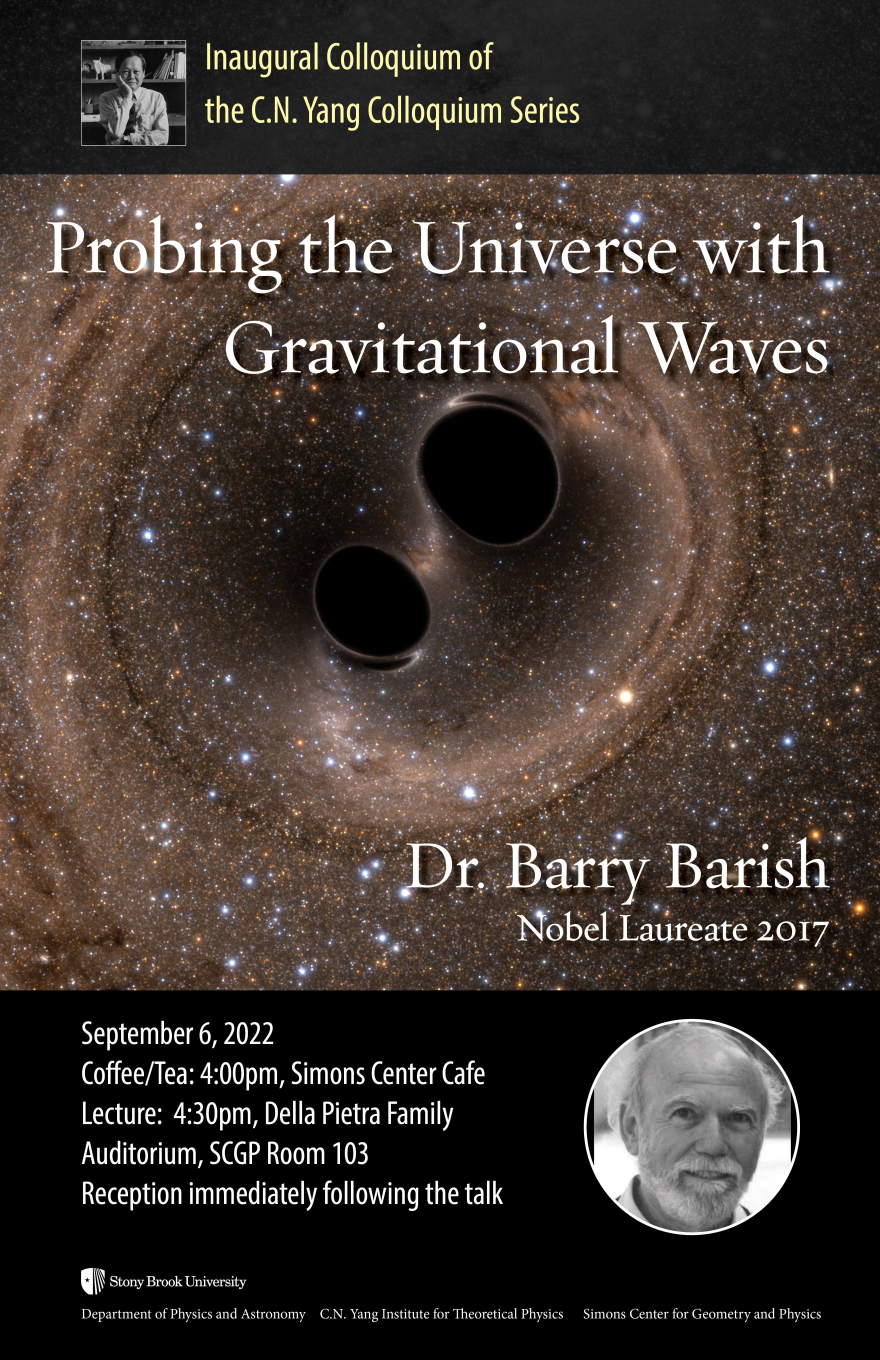
Sep 13
Chang Kee Jung
Stony Brook University
Chair's Colloquium
Sep 20
--
No colloquium.
Sep 27
--
No colloquium.
Oct 4
Mariangela Lisanti
Princeton
Galactic Probes of Fundamental Dark Matter Physics
The hypothesis of Cold Dark Matter (CDM) has been spectacularly confirmed on the largest scales of the Universe and must now be stress-tested on galactic scales. Many well-motivated and generic alternatives to CDM can leave spectacular signatures on precisely these scales, affecting the evolution of galaxies as well as their population statistics. Excitingly, over the course of the next decade, a flood of astrophysical data will open the possibility of searching for these distinctive imprints and shedding light on key questions about dark matter. In interpreting such results, systematic studies using both semi-analytic codes and numerical simulations will play a critical role in robustly disambiguating dark matter signals from other standard baryonic processes. As a concrete example in this talk, I will describe the consequences for galaxy formation when new forces mediate interactions between dark matter particles, highlighting key observables for future studies.
Oct 11
Fall Break. No colloquium.
Oct 18
Peter Denton
Brookhaven National Laboratory
Knowns and Unknowns in Neutrinos
In particle physics there exist two regions: the Standard Model which is fairly complete and the new physics sector which is completely unknown. Inbetween and overlapping with both of these is neutrino physics. Neutrinos exist within the Standard Model but are not explained by it due to the discovery of neutrino oscillations. In this colloquium I will discuss where we stand with neutrino oscillations, where we might go with them, and how we might learn about the nature of neutrinos.
Oct 25
Talat Rahman
University of Central Florida
The Importance of Being Imperfect: Defected 2D Materials for a Sustainable Future
In the pursuit of a sustainable future, the last decade has seen a concerted effort in accelerating the discovery of materials for energy needs, thanks to a large extent to the Materials Genome Initiative. In this talk I will focus on few 2-dimensional materials which have captured our imagination. As with graphene, another common lubricant, molybdenum disulphide (MoS2) shows remarkable optical properties when peeled off as single sheet. I will show how defects and dopants in single-layer MoS2 transform its electronic structure so that it turns into a catalyst for CO hydrogenation. Even more interesting is the case of another 2D material, good old hexagonal boron nitride (h-BN), an avowed insulator. Defects, however, can transform it into a material that, on the one hand, captures and converts CO2 to value added products and, on the other, functions as a single photon emitter akin to NV centers in diamond. With a focus on electronic structural modulations of the local environment, I will draw comparisons with experimental observations made in collaborative work.
Nov 1
Robert Crease
Stony Brook University
The Leak: The Life and Untimely Death of Brookhaven's High Flux Beam Reactor
In 1997, a small leak of tritium-containing water from the spent fuel pool of the HFBR (High Flux Beam Reactor) triggered a media and political firestorm that resulted in the reactor's shutdown and calls to close the laboratory. A quarter-century later, the episode embodies the dynamics of controversies in which fears and political agendas disrupt serious discussion and research of vital issues.
Robert P. Crease is a Professor in and Chair of the Stony Brook Department of Philosophy. For 22 years he has written a column for Physics World, "Critical Point," on the historical and philosophical dimensions of science. He won the 2021 Institute of Physics Kelvin Medal for "describing key humanities concepts for scientists, and explaining the significance of key scientific ideas for humanists." His most recent book (with Peter Bond) is The Leak: Politics, Activism, and Loss of Trust at Brookhaven National lLaboratory (MIT Press).
Nov 8
Election Day. No colloquium.
Nov 15
Jen Cano
Stony Brook University
A New Era of Topological Materials
Topology plays an important role in our understanding of quantum matter. The topological classification of electronic bands gives rise to “topological insulators.” These phases are not only mathematically elegant, but also exhibit unusual physical properties sought after for next generation quantum electronics. While the past decade marked the search for topological materials, the goal of the next decade will be to detect, engineer, and manipulate their properties. I will describe theoretical advances that have broadened the classification of topological phases, giving rise to new probes and materials. Finally, I will introduce “topological twistronics” as a novel tuning knob to manipulate these exotic phases of matter.
Nov 22
Thanksgiving Break. No colloquium.
Nov 29
Giacinto Piacquadio
Stony Brook University
Beauty (quarks) and the Higgs as Window into New Physics at the LHC
Ten years ago, the discovery of the Higgs boson based on proton-proton collisions at the Large Hadron Collider provided experimental confirmation of the mechanism that gives elementary particles their mass. Today the Run-2 and Run-3 datasets, with their record-breaking proton-proton intensity and the highest collision energies ever produced by mankind, are enabling ATLAS and CMS experiments to perform measurements of the newly discovered particle with unprecedented precision, providing stringent tests for an increasing class of new physics models. After giving a general overview of the status of the field, I will explain why beauty quarks, the particles to which the Higgs boson decays more abundantly, represent such a challenging yet essential tool to study the Higgs boson, and how the deployment of machine learning tools is helping us extend the discovery reach to previously unexplored scenarios. Finally, I will discuss the prospects for Higgs boson measurements during the High-Luminosity phase of the LHC.
Dec 6
Valeria Molinero
University of Utah
Molecular Recognition of Ice by Proteins: From Ice Nucleation to Antifreeze
Bacteria, insects and fish that thrive at subfreezing temperatures produce proteins that bind to ice and manage its formation and growth. Ice binding proteins include antifreeze proteins, that stop the formation of ice, and ice-nucleating proteins, that promote it. This presentation will discuss what makes proteins so outstanding at recognizing and binding ice, what distinguishes ice nucleating and antifreeze proteins, and how can we use that knowledge to engineer new molecules for a range of applications, from seeding clouds to induce precipitation to cryopreservation.
Date Speaker Title & Abstract Feb
1
Navid Vafaei-Najafabadi
Stony Brook University
Recruiting the 4th state of matter to miniaturize particle accelerators
Particle accelerators have been an invaluable tool for scientific discovery and research. Future discoveries in high energy physics will require significantly more energetic particles than those currently produced. However, simply scaling the current machines to higher energies is a significant challenge because of their cost as well as the required space. A fundamental limitation that dictates the size of these machines is that the peak electric field used for accelerating particles must be below the damage threshold of the accelerating structures. Using a plasma, an ensemble of ionized atoms also known as the fourth state of matter, this limitation can be circumvented. In particular, high amplitude waves can be generated in a plasma using a high-power laser or a particle beam. The resulting structures have been shown to sustain accelerating fields that are hundreds of times higher than those currently generated in particle accelerators. In this talk, I will discuss how plasma waves are particularly well suited for accelerating electrons, the status of the state-of-art research, as well as the challenges that need to be overcome for plasma-based accelerators to form the foundation of next generation of high-energy particle beams.
Feb
8
Wendy Freedman
University of Chicago
This colloquium will be fully virtual.
Increasing Accuracy in Measurements of the Hubble Constant: Is There Evidence for New Physics?
An important and unresolved question in cosmology today is whether there is new physics that is missing from our current standard Lambda Cold Dark Matter (LCDM) model. Recent measurements of the Hubble constant, Ho -- based on Cepheids and Type Ia supernovae (SNe) -- are discrepant at the 4-5-sigma level with values of Ho inferred from measurements of fluctuations in the cosmic microwave background (CMB). The latter assumes LCDM, and the former assumes that systematics have been fully accounted for. If real, the current discrepancy could be signaling a new physical property of the universe. I will present new results based on an independent calibration of SNe Ho based on measurements of the Tip of the Red Giant Branch (TRGB). The TRGB marks the luminosity at which the core helium flash in low-mass stars occurs, and provides an excellent standard candle. Moreover, the TRGB method is less susceptible to extinction by dust, to metallicity effects, and to crowding/blending effects than Cepheid variable stars. I will address the current uncertainties in both the TRGB and Cepheid distance scales, the promise of upcoming James Webb Space Telescope data, as well as discuss the current tension in Ho and whether there is need for additional physics beyond the standard LCDM model.
Feb 15
Jin Koda
Stony Brook University
Increasing Accuracy in Measurements of the Hubble Constant: Is There Evidence for New Physics?
Molecular gas and molecular clouds host virtually all star formation in the local Universe, and therefore their formation and evolution are the first step leading to star formation and galaxy evolution. In this talk, I will argue for long life and evolutional timescales of molecular gas and clouds (~>100Myr), as opposed to the recently-(again)-suggested short timescales (10-30Myr), by looking at their evolution through galactic rotation, i.e., how they form and evolve through spiral arms and inter-arm regions, in the Milky Way and in nearby galaxies. Although the popular spiral density-wave theory predicts a rapid phase transition from atomic to molecular and then to atomic phases through spiral arm passages, the observed fraction of molecular gas over atomic gas remains high even in the inter-arm regions in MW-like spiral galaxies. Hence, the molecular gas and clouds are not destroyed much toward the inter-arm regions. Recent ALMA data show diverse molecular structures in the inter-arm regions of nearby galaxies, many of which contain large masses. Their formation requires very long timescales (~100Myr) just to assemble the masses. If they are destroyed quickly in the short timescales, their formation would not catch up with the destruction; the galaxies should have much more atomic gas than the observed. The long life and evolutional timescale of molecular gas impacts the picture of star formation - the star formation has to be triggered in the long-existing molecular structures, rather than starting at an onset of gravitational collapse from diffuse atomic gas to dense molecular clouds.
Until August 14, 2022, a recording of this colloquium may be accessed here, using the following passcode:
91.?S1YDFeb 22
Murray Holland
University of Colorado Boulder
Extreme sensing, clocks, and squeezing atoms and molecules with light
I will describe recent ideas for lowering the temperature of ensembles of ultracold atoms and molecules into the extreme quantum regime, for using interactions to entangle atoms and molecules into non-classical quantum states, and for using these non-classical states to realize quantum advantages for metrology, clocks, and matter-wave interferometry. One such topic is a new experimentally demonstrated idea for laser cooling by Sawtooth Wave Adiabatic Passage (SWAP). This is mostly relevant to atoms and molecules that possess narrow linewidth transitions, such as the ultranarrow clock transitions, and promises to be an important extension to the toolbox of AMO physics for laser cooling and trapping. We are exploring ways to use optical cavities and cavity-mediated interactions to entangle atoms so that we may improve optical clock performance, make repeated quantum measurements beyond the standard quantum limit, and continuously track squeezed quantum phases. These approaches take full advantage of the powerful combination of the extreme optical coherence that is possible using atomic clocks, with the rich possibilities offered by many-body physics that arises when the atoms interact strongly. Atomic clocks have already progressed to the point that understanding how to take advantage of quantum effects will be crucial in order to progress to the next generation of devices.
Until August 21, 2022, a recording of this colloquium may be accessed here, using the following passcode:
=3V&hEVnMar 1
No colloquium.
Mar 8
Laura Cadonati
Georgia Institute of Technology
Exploring the cosmic graveyard with gravitational waves
A new era in astrophysics has begun with the 2015 discovery of gravitational waves from the collision of two black holes in data from the Laser Interferometer Gravitational-wave Observatory (LIGO). The additional 2017 LIGO-Virgo detection of gravitational waves from the collision of two neutron stars in coincidence with a gamma ray burst and a kilonova, elevated multi-messenger astrophysics from concept to tool for discovery and exploration. Many more gravitational wave signals have been observed since then from collisions of compact binary coalescence, and gravitational waves are a new, important probe for understanding the universe, with a rich science potential ranging from astronomy to cosmology to nuclear physics. This talk will present a selection of the latest results from LIGO and Virgo, with their GWTC-3 gravitational wave transient catalog, and an outlook for the next decade.
Mar 22
Alexandra Gade
Michigan State University
This colloquium will be fully virtual.
The science of FRIB: From the nuclear many-body challenge to the origin of the elements in the Universe
There are approximately 300 stable and 3,000 known unstable (rare) isotopes. Estimates are that over 7,000 different isotopes are bound by the nuclear force. It is now recognized that the properties of many yet undiscovered rare isotopes hold the key to understanding how to develop a comprehensive and predictive model of atomic nuclei, to accurately model a variety of astrophysical environments, and to understand the origin and history of elements in the Universe. Some of these isotopes also offer the possibility to study nature's underlying fundamental symmetries and to explore new societal applications of rare isotopes. This presentation will give a glimpse of the opportunities that arise once the Facility for Rare Isotope Beams (FRIB) comes online at Michigan State University in a few weeks.
Until September 18, 2022, a recording of this colloquium may be accessed here, using the following passcode:
&n5*qKQKMar 29
Dmitry Tsybychev
Stony Brook University
Experimental studies of the electroweak symmetry breaking at CERN Large Hadron Collider
Understanding of electroweak symmetry breaking mechanism is one of the highest priority problems facing the field of high-energy physics and most importantly whether such breaking occurs solely through the weak interactions. The divergence of electroweak interactions in the Standard Model of particle physics, in particular, scattering of longitudinally polarized of heavy gauge bosons, at the TeV scale is solved by introduction of a Higgs boson. We will present studies of the electroweak symmetry breaking at ATLAS experiment at the Large Hadron Collider (LHC), operating at center-of-mass energies of 7-14 TeV, the highest collision energy in the world.
Until September 25, 2022, a recording of this colloquium may be accessed here, using the following passcode:
d?n9qHseApr 5
Heather Gray
Berkeley
Computing Challenges for Future Colliders — could quantum computing play a role?
High-energy physics is facing a daunting computing challenge with the large and complex datasets expected from the HL-LHC in the next decade and future colliders to follow the LHC. The landscape of computing has been evolving rapidly and field of quantum computing in particular has been making dramatic progress in recent years. I will outline the challenges facing high-energy physics, provide a brief introduction to quantum computing focusing on recent progress and discuss recent work that may lead to solutions for high-energy physics.
Apr 12
Dave Kawalll
University of Massachusetts
An Anomaly in an Anomaly? First Results from the Fermilab Muon g-2 Experiment
The Fermilab muon g-2 experiment recently released its first measurement of the magnetic behavior of the muon. Muons are like electrons, but heavier and short-lived. Their magnetic properties can be predicted with impressive, sub-ppm precision through the techniques of quantum field theory. An interesting feature is that an accurate prediction requires the addition of quantum corrections that arise due the interactions of the muon with all the other fundamental particles of nature such as electrons, photons, quarks, etc. Comparison of experimental results with theoretical predictions then serves as a powerful test of the completeness of the Standard Model of nature, and the long-standing discrepancy we observe might indicate the need for new physics. The concepts behind the Fermilab experiment and the many challenges it faces will be presented, along with the comparison with theory and future prospects.
Until October 9, 2022, a recording of this colloquium may be accessed here, using the following passcode:
CyYyXU$0Apr 19
Mark Palmer
Brookhaven National Laboratory
An Energy Frontier Muon Collider: Progress Towards a Machine to Drive Particle Physics Discovery
Muon colliders offer a unique path to multi-TeV, high-luminosity lepton collisions. Muon collisions with a center-of-mass energy of 10 TeV or above would offer significant discovery potential where the constituent collision energies exceed those of the LHC program by an order of magnitude. Significant progress on the fundamental R&D and design concepts for such a machine has led to a new international effort to assemble a conceptual design within the next few years. This effort will assess the viability of such a machine as a successor to the LHC program. The remaining challenges and the R&D required to deliver a complete machine description will be described.
Until October 16, 2022, a recording of this colloquium may be accessed here, using the following passcode:
b*&J29Z8Apr 26
John Wilkerson
University of North Carolina
This colloquium will be fully virtual.
Probing the elusive nature of neutrinos
Neutrinos, enigmatic fundamental particles, were long assumed to be massless until a series of revolutionary experiments over the past two decades revealed that they actually exhibit complex behavior and must possess non-zero mass. From these and other recent measurements we know that neutrinos have minuscule masses, at least 500,000 times lighter than the electron. Yet we still do not know the neutrino’s actual mass nor why it is so light? Nor do we understand their fundamental nature, are they Dirac or Majorana particles? If neutrinos are their own antiparticles, Majorana neutrinos, then this would provide an explanation for their elusive lightness while at the same time offering a potential explanation of the universe’s observed matter - antimatter asymmetry. This talk will briefly review our current understanding of neutrinos, their role in cosmology, astrophysics, and fundamental interactions, and then address the questions of both how one “weighs” a neutrino and how to determine its Dirac or Majorana nature. The techniques and latest results from cosmology, direct kinematical methods, and double beta decay will be presented.
Until October 23, 2022, a recording of this colloquium may be accessed here, using the following passcode:
H4Uq.v$1May 3
Matthew Dawber
Stony Brook UniversityGraduate Colloquium
Date
Speaker
Title & Abstract
Aug 31
Matthew Dawber
Stony Brook University
Building better functional materials with advanced deposition and x-ray diffraction
If the oft-quoted maxim in materials design is that “the whole is more than the sum of the parts”, it is also true that “the devil is in the details”. In the case of ferroelectric oxides, this is especially true. Our work in building artificially layered heterostructure of these materials has shown that their key functional properties, including the nanoscale arrangement of electrical polarization and their ability to act as photocatalysts to generate hydrogen fuel, are determined by events that occur during their fabrication. They also depend strongly on tiny details such as the precise arrangement of atoms on their surfaces. Hence we will add to our list of handily appropriate sayings, “the journey is as important as the destination”.Historically, the approach to material fabrication has largely been like taking a red-eye with your eyeshades on, you know where you started and where you land, but have very little idea about what happened in between. (It’s also pretty tedious and uncomfortable).Through the use of synchrotron x-ray diffraction performed in-situ during growth and other dynamic processes we have begun to peel off the eyeshades, learning a great deal about the processes and also developing insight into how we can influence the processes at key points to greatly enhance the final properties of our materials. It’s a bit like being awake when the meal cart goes by, i.e., very much to your advantage!Sept 7
Chang Kee Jung
Stony Brook University
Chairs Colloquium
Sept 14
Gregory Falkovich
Weizmann Institute
Physical Nature of Information
How much can we do and say about something we do not know? Trying to answer this question quantitatively brought us thermodynamics, statistical mechanics and information theory. I shall present a brief history of these developments, emphasizing the analogies in the limits imposed by uncertainty on engines, measurements, communications and computations. The review is panoramic aiming to show that the people working on quantum computers and the entropy of black holes use the same tools as those designing self-driving cars and market strategies, studying molecular biology, animal behavior and human languages, and figuring out how the brain works. I’ll finish with some recent applications to turbulence as an ultimate far-from-equilibrium state with the lowest entropy.
October 19
Xiaoxing Xi
Temple University
Crackdown on Academic Collaboration with China Harms American Science
Academic collaboration with China was once encouraged by the US government and universities. As tension between the two countries rises rapidly, those who did, especially scientists of Chinese descent, are under heightened scrutiny by the federal government. Law enforcement officials consider collaborating with Chinese colleagues “by definition conveying sensitive information to the Chinese.” In 2015, I became a casualty of this campaign despite being innocent. “China Initiative” established by the Justice Department in 2018 has resulted in numerous prosecutions of university professors for alleged failure to disclose China ties. In this talk, I argue that academic decoupling is not in America’s interest. It is a tall order to convince the public and policy makers of this fact, but the scientific community must try lest the American leadership in science and technology will be irreparably damaged.
November 2
Angela Kelly
Stony Brook University
Access and Equity in the Physics Education Pipeline
Science, technology, engineering, and mathematics (STEM) careers have traditionally served as mechanisms for socioeconomic advancement in the U.S., yet participation in academic coursework that prepares students for the STEM workforce has not been equitable. Recent calls for reform in physics education have highlighted persistent disparities in access and equity for traditionally underrepresented populations in precollege and university settings. The Institute for STEM Education (I-STEM) at Stony Brook houses the Ph.D. Program in Science Education, where faculty and researchers examine important questions related to STEM educational outcomes. This colloquium will present recent research exploring three main segments of the physics education pipeline: (1) physics educational opportunities, participation, and teacher quality in high school settings; (2) science academic gatekeeping in community colleges; and (3) undergraduate experiences in physics, particularly remote laboratory classes. Findings utilizing a variety of research methodologies will be presented, along with implications for policy and practice in physics education.
November 9
Sergey Syritsyn
Stony Brook University
A more perfect Universe: the role of lattice QCD in constraining fundamental symmetry violations
Violations of fundamental symmetries, in particular CP(charge*parity) and baryon number conservation, are immensely important to understanding the origin of matter in the Universe. Evidence for such violations, such as proton decay, neutron-antineutron oscillation, and the neutron electric dipole moment, have not yet been observed despite decades of dedicated experiments. In these searches, the common "probes" are protons and neutrons. Precise knowledge of their structure in terms of their elementary constituents, quarks and gluons, is crucial to connecting experimental bounds to theories incorporating symmetry violations. In my talk, I will review the role, the methods, and the status of Quantum Chromodynamics calculations on a lattice that connects quark-gluon interactions and nucleon structure.
November 16
Anja von der Linden
Stony Brook University
Cosmology with Galaxy Clusters
The observed number of galaxy clusters provides a sensitive probe of the structure of the Universe, including dark energy, by measuring the evolution of the halo mass function. However, already current cluster surveys are systematically limited by uncertainties in the relation between cluster mass and observables (e.g. number of galaxies, X-ray luminosity, or the imprint on the Cosmic Microwave Background). I will discuss the challenges in determining mass-observable relations, and how the combination of weak gravitational lensing and X-ray observations can address these. I will review current cluster cosmology results, including those from the "Weighing the Giants" project which placed some of the tightest single-probe constraints on dark energy to date. I will comment on how cluster triaxiality and orientation bias can alleviate the surprisingly low matter density inferred from clusters in the Dark Energy Survey. I will conclude with an outlook towards cluster cosmology with future sky surveys, in particular the Vera C. Rubin Observatory's Legacy Survey of Space and Time (LSST).
November 30
Xijie Wang
SLAC
Watch water molecules dancing with MeV electronsWater is one of the most important, yet least understood, liquids in nature. Many strange properties of liquid water, such the highest density at 39 degrees Fahrenheit and high surface tension, originate from its well-connected hydrogen bond network. A complete unveiling of the intermolecular dynamics of water requires direct time- and structure-resolved measurements. It is a challenge to use X-ray or neutron scattering to study water’s hydrogen bond structure dynamics due to the lacking in scattering sensitivity (X-ray) or time resolution (neutron). Recent developments in megaelectronvolt electron ultrafast electron diffraction (MeV-UED) [1-3] made it possible, for the first time, watching water molecule interacts with its neighbors [4] and formation of the short-lived hydroxyl-hydronium pair of the ionized water molecule [5]. Our experiment directly observed the quantum mechanical nature of how the hydrogen atoms are spaced out, and this quantum effect could be the missing link in theoretical models describing strange properties of water. I will also discuss development of MeV-UED - a new paradigm in ultrafast electron scattering.
 Late Prof. C.N. "Frank" Yang: 1922 - 2025