
New Technique Shows How a Protein “Light Switch” Works May Enhance Biological Research
Peter Tonge, Department of Chemistry
 Sunlight is essential for all life, and living organisms have evolved to sense and
respond to light. Dronpa is a protein “light switch” that can be turned on and off
by light. A team of scientists led by Peter Tonge, a Professor in the Department of Chemistry, has discovered a way to use infrared
spectroscopy to determine for the first time structure changes that occur in Dronpa
during the transition from the dark (off) state to the light (on) state. Their findings
are reported in a paper published early online in Nature Chemistry.
Sunlight is essential for all life, and living organisms have evolved to sense and
respond to light. Dronpa is a protein “light switch” that can be turned on and off
by light. A team of scientists led by Peter Tonge, a Professor in the Department of Chemistry, has discovered a way to use infrared
spectroscopy to determine for the first time structure changes that occur in Dronpa
during the transition from the dark (off) state to the light (on) state. Their findings
are reported in a paper published early online in Nature Chemistry.
According to Tonge, the technique and their findings will help the researchers understand how this “light switch” works and enable them to redesign Dronpa for applications in biology and medicine.
“A key challenge in understanding how the switch works in Dronpa is to determine how the initial interaction of light - which happens very, very fast – in less than one quadrillionth of a second – changes the dynamics and ultimately turns the switch on in a process that occurs millions of times more slowly.
In our work we used an instrument that can look at the vibrations of Dronpa over many decades of time so that we could visualize the entire activation process in one experiment,” he explained.
The study was funded by the National Science Foundation (CHE-1223819), and the EPSRC (EP/N033647/1 and EP/M001997/1).
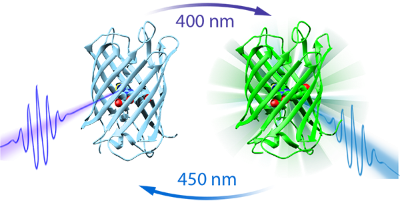
This image depicts how the Dronpa light switch can be turned on or off by using different
colors of light (at 400 or 450 nm).